# Ultimate Technical Breakdown of the MITRE Ecosystem
***
## Why MITRE?
MITRE’s ecosystem is the strategic backbone of modern cyber operations. It enables us to **model adversary behaviour**, **map security controls**, **automate simulation**, and **validate detection**, all while **maintaining standardization** that allows SOCs, researchers, and pentesters to speak a **universal language of cyber threats.**
#### MITRE Ecosystem
* **MITRE ATT\&CK:** *A globally adopted matrix of adversary tactics and techniques for modelling real-world cyber threats.*
* **MITRE D3FEND:** A defensive counterpart to ATT\&CK, mapping mitigation techniques to specific attacker behaviors.
* **MITRE ENGAGE (formely SHIELD):** A proactive adversary engagement framework for deception, delay, and intel gathering.
* **MITRE CALDERA:** An automated red team platform that emulates adversaries using ATT\&CK-mapped attack chains.
* **MITRE ATLAS:** A threat model framework targeting AI/ML systems, focused on securing data, models, and pipelines.
## MITRE ATT\&CK — The Behavioural Mapping Matrix
{% embed url="" %}
***
MITRE ATT&CK Homepage
### **Technical Summary:**
MITRE ATT\&CK is a **post-compromise behavioural mapping system**. Instead of focusing on malware signatures or IOCs, it categorizes how adversaries behave once they’ve infiltrated a system, using **Tactics → Techniques → Sub-techniques.**
### **Structure:**
ATT\&CK Matrices are organized into:
**Enterprise Matrix:**
* Covers Windows, Linux, macOS, SaaS, Cloud (AWZ, Azure, GCP), Network, and containers.
* Best for red teams, blue teams, and hybrid SOCs.
**Mobile Matrix:**
* Covers Android and iOS specific techniques (e.g., exploiting mobile apps, SMS phishing, etc).
**ICS Matrix:**
* Covers Industrial Control System, attacks on critical infrastructure (power grids, manufacturing, etc).
### **Structural Model:**
* **Tactics:** Goals of the adversary (e.g., Defense Evasion).
* **Techniques:** How those goals are achieved (e.g., Obfuscated Files).
* **Sub-Techniques:** Variants/implementations (e.g., Base64 Encoding).
* **Procedure Examples:** Real-world adversary implementations (APT29, Wizard Spider).
* **Data Sources:** Suggested log types (e.g., process monitoring, registry access).
### **Technical Use Case: Detection Engineering**
* TTP: `T1055.002` — `Process Injection`: `Portable Executable Injection`
* Detection: Monitor memory allocation APIs like `VirtualAllocEx()` and `WriteProcessMemory()`
* Logs: Sysmon Event ID 10 (ProcessAccess), ETW, EDR telemetry.
#### TTP Examples:
## MITRE D3FEND → The Countermeasure Matrix
{% embed url="" %}
***
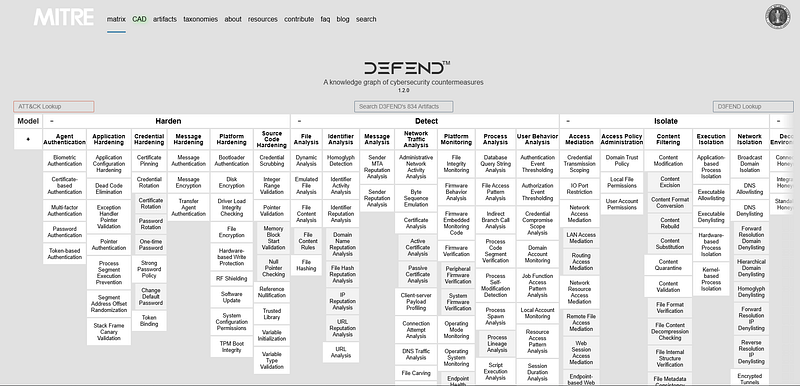
MITRE D3FEND Homepage
### **Technical Summary:**
D3FEND flips the ATT\&CK perspective, focusing on **defensive counter-techniques** mapped directly to attackers behaviors. It emphasizes **telemetry, prevention, and analytics.**
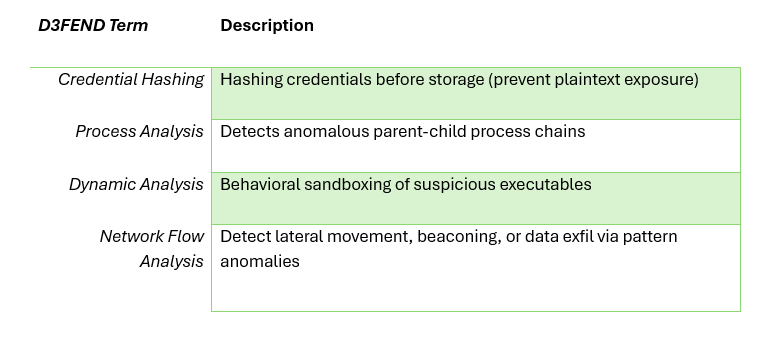
### **Key Defensive Techniques:**
### **Technical Use Case: SOC Playbook Development**
**Mapping:**
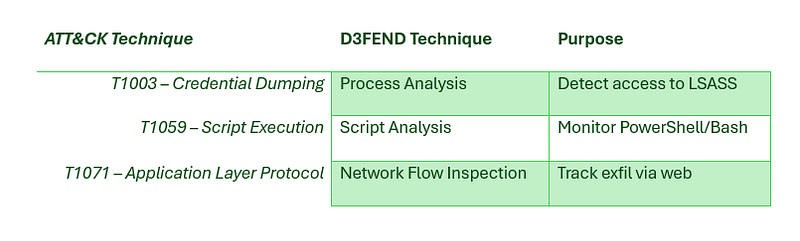
* ATT\&CK → `T1003.001` — `LSASS Memory Dumping`
* D3FEND → `Process Analysis`, `Endpoint Memory Analysis`
### **ATT\&CK ←→ D3FEND Mapping:**
## MITRE Engage → The Modern Adversary Engagement Framework
{% embed url="" %}
***
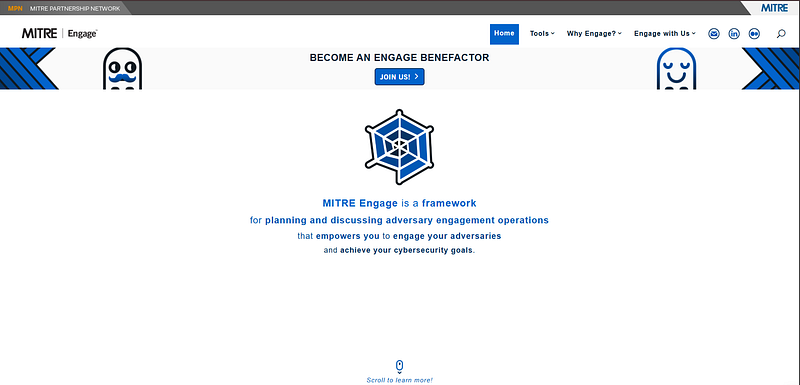
MITRE ENGAGE Homepage
### **Technical Summary:**
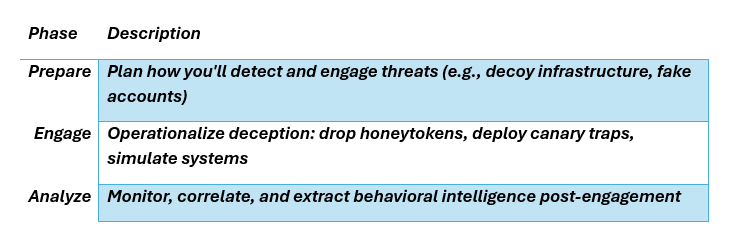
**MITRE Engage** is the **evolution of MITRE SHIELD**, expanding beyond just deception to support **strategic, proactive adversary interaction** across the **full engagement lifecycle**.
It equips defenders with structured practices to:
* Delay attackers
* Confuse or mislead them
* Collect high-fidelity intelligence
* Measure success with operational outcomes
### **Core Components:**
### **From SHIELD to Engage:**
Previously known as **MITRE SHIELD**, this framework started as a **deception knowledge base**. Now under **Engage**, it encompasses broader **active defense tactics** with measurable effects and mission alignment.
### **Real-World Use Case:**
#### **Deceptive Credential Trap in Cloud CI/CD Pipelines**
Embed fake AWS API keys into a GitHub repo (e.g., `config_example.yml`)
Keys are monitored using services like Canarytokens or custom webhooks
When accessed:
* Immediate alert is triggered
* Attacker’s IP, User-Agent, and behavior logged
* Responders isolate the session, redirect traffic, or deploy more traps
#### **Technical Practice Categories (Adapted from SHIELD):**
```
# Monitor honeytoken credential usage
if (auth_logs contain "fake-admin") {
trigger alert;
isolate source IP;
launch post-engagement logging;
}
```
## MITRE CALDERA — Adversary Emulation Platform
{% embed url="" %}
***
MITRE CALDERA Homepage
### **Technical Summary:**
CALDERA is a **plugin-based red team automation framework** that leverages ATT\&CK data to simulate real attack paths. It uses autonomous agents and emulation profiles like **APT29**, **FIN7**, etc.
### **Architecture:**
* **Agents:** Sandcat (default), Manx (reverse shell), Vector (cloud ops).
* Abilities: Mapped to ATT\&CK techniques.
* Operations: Chain of techniques executed in sequence.
* Facts: Extracted intel (e.g., username, hostnames) injected into future steps.
### **TTP Simulation Examples:**
#### **Technical Use Case: APT29 Simulation**
Operation: Custom APT29 chain
Execution:
* **Initial Access:** `T1556.001` — `Spearphishing Attachment`
* **Execution:** `T1059` — `PowerShell`
* **Credential Dumping:** `T1003.001` — `LSASS`
**Outcome:** Evaluate if EDR detects chain, generate timelines of missed alerts.
## MITRE ATLAS — AI/ML Threat Framework
{% embed url="" %}
***
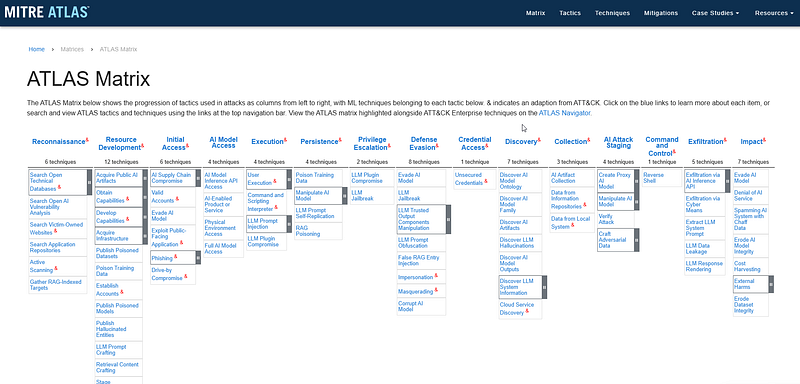
MITRE ATLAS Full Matrix
### **Technical Summary:**
ATLAS is designed for **threat modelling of machine learning systems**, covering attacks on **data pipelines, models, and inference layers**.
### **Core Concepts:**
* **Data Attacks**: Poisoning datasets to skew learning
* **Model Attacks**: Query-based model stealing, reverse engineering
* **Inference Attacks**: Extracting private training data (e.g., membership inference)
### **TTP Example:**
### **Technical Use Case: AI Red Teaming**
* **TTP:** `Data Poisoning in Federated Learning`
* **Scenario:** Adversary uploads crafted training set to bias global model
* **Detection:** Monitor drift in model weights across aggregation rounds
## MITRE Engenuity ATT\&CK Evaluations
{% embed url="" %}
### **Technical Summary:**
MITRE Engenuity conducts **transparent, technique-mapped evaluations** of EDR/XDR tools using real-world adversary playbooks.
### **Evaluation Data:**
**APT Profiles**: FIN7, Sandworm, Carbanak
**Test Stages**: Initial Access → Execution → Lateral Movement → Impact
### **Scoring**:
* **Visibility**
* **Detection Type (Alert/Telemetry)**
* **Configuration Dependency**
### **Technical Use Case: EDR Procurement**
* Evaluate detection coverage across TTPs
* Use reports to select vendors aligned with your environment’s risk profile
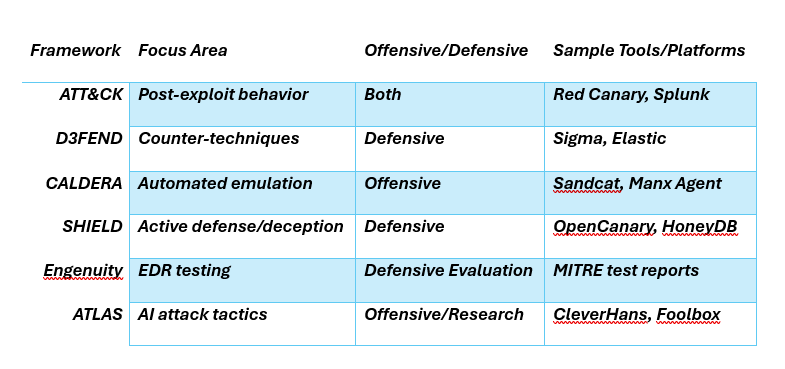
### Infographic Mapping Template
## Full Ecosystem Integration Flow
## Advanced Integration Pro Tips
* **ATLAS** = use in conjunction with threat modeling tools like STRIDE or PASTA for AI.
* **D3FEND** = enrich SIEM rules with mapped techniques.
* **CALDERA** = schedule red team ops with auto-generated MITRE mapping.
* **SHIELD** = pair with Elastic/Splunk to trigger alerts from decoys.
* **Engenuity** = develop a “heatmap gap” report for your SOC maturity model.
## Conclusion
The MITRE ecosystem isn’t just a collection of matrices — it’s an **operational framework for modern cybersecurity**, blending offense, defense, deception, and automation into one. Mastering this ecosystem = leveling up your red, blue, or purple capabilities.